

Uranium Recovery (Extraction) Methods
Uranium is found in mineral deposits worldwide, with over one-half of the world’s uranium production today derived from mines located in Canada, Australia, and Kazakhstan. Uranium-bearing ores are mined by methods similar to those used for other metal ores. The uranium ore is removed from the ground by conventional mining techniques, in-situ recovery method, or as a by-product of other minerals.
Conventional Mining
Uranium deposits less than 100 meters from the surface can be recovered using the open-pit mining method while deposits more than 100 meters deep in the earth use the underground mining method, both of which are in the category of conventional mining.
Open-pit/Opencast/Opencut
Open-pit mining starts with the removal of overburden (material covering) on top of the uranium to expose the orebody. A pit is then hollowed out to access the deposit. To prevent the pit’s walls from caving in, the rock is mined in a series of benches. Holes are drilled into the rock in each bench and loaded with explosives. The explosives are then detonated to break up the rock, which would be taken to the surface by large trucks. The world’s largest open-pit uranium mine in operation today is the Rössing mine in Namibia.
Underground
To access a uranium orebody deep underground, vertical shafts are dug to the depth of the deposit. Next, tunnels are cut around the orebody. Drifts (horizontal tunnels) provide direct entry in to the deposit and ventilation pathways. In most underground mines, the orebody is then blasted and hoisted to the surface for milling. For mining to be viable, these deposits must be comparatively high grade. Cameco and AREVA’s McArthur River mine is the largest high-grade uranium deposit.
In-situ recovery/In-situ leaching/Solution mining
Uranium ore can also be recovered by the in-situ recovery (ISR) method, given appropriate geological conditions. The ISR method is applicable only to sandstone-hosted uranium deposits located below the water table in a confined aquifer. ISR is a method that leaves the uranium orebody in the ground. The uranium is dissolved in either sulfuric acid or a mildly alkaline solution that is injected into and recovered from the aquifer by means of wells. The uranium-bearing solution is then pumped back up to the surface, leaving the rock undisturbed. Nearly one-quarter of the uranium mines use the ISR method and nearly all of Kazakhstan’s uranium mines use this method.
Uranium Extraction and Processing
There are two principal methods of ore processing:
- Extraction of ore from the ground (via underground mines or open pits). The ore is transported to a
central facility, crushed and milled. The milled ore is further processed via heap leaching or batch leaching
(autoclave, tank, vat leach). The leached pulp may be treated ‘as is’ in a resin-in-pulp (RIP) configuration,
or solid-liquid separation may be done via belt filters or counter-current decantation (CCD) to produce a
clarified or partially clarified liquor that forms the feed to the ion exchange unit operation.
- In situ treatment, also referred to as In Situ Leach (ISL) or In Situ Recovery (ISR). This technique involves
dissolving uranium directly from the ore body using appropriate lixiviants while the ore remains underground.
The lixiviant is pumped into the ground via a series of injection points. Pregnant leach solutions (PLS) is
collected from a central well. ISL produces “clean” PLS with Total Suspended Solids (TSS) less than 50 ppm.
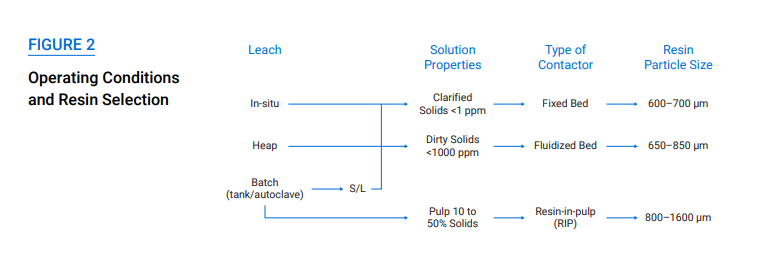
The choice of ion exchange contactor is dependent on the solids content of the feed material. This in turn,
dictates the optimum particle size distribution of the resin, as show in Figure 2.
Uranium Extraction Resins
Uranium extraction resins, specifically strong-base anion exchange resins, are used in the mining industry to recover uranium from leach liquors after the ore is processed. These resins bind to uranium ions, allowing for efficient separation and purification.
How it works:
Leaching:
Uranium ore is crushed, ground, and then leached with chemicals (like sulfuric acid) to dissolve the uranium.
Ion Exchange:
The leach liquor, containing uranium, is then passed through columns filled with strong-base anion exchange resin.
Uranium Adsorption:
The uranium ions (in the form of anionic complexes) are selectively adsorbed onto the resin beads.
Elution:
The uranium is then eluted (or removed) from the resin using a different solution (e.g., dilute sulfuric acid).
Purification and Precipitation:
The resulting uranium solution is further purified and then precipitated as a concentrate, often in the form of yellowcake.
Types of Resins:
Strong-base anion exchange resins:
These are the most common type used for uranium extraction, known for their high affinity for uranium ions.
Macroporous vs. Gel-type:
Both macroporous and gel-type resins are used, with macroporous resins offering higher resistance to physical and chemical degradation.
Benefits of Using Resins:
High recovery rates: Resins can achieve high uranium recovery rates from the leach liquor.
Purification: They effectively remove impurities from the uranium solution.
Versatility: They can be used in various uranium mining processes, including both fixed-bed and fluidized-bed operations.
Cost-effective: Resin-based uranium extraction is generally a cost-effective method compared to other extraction techniques.